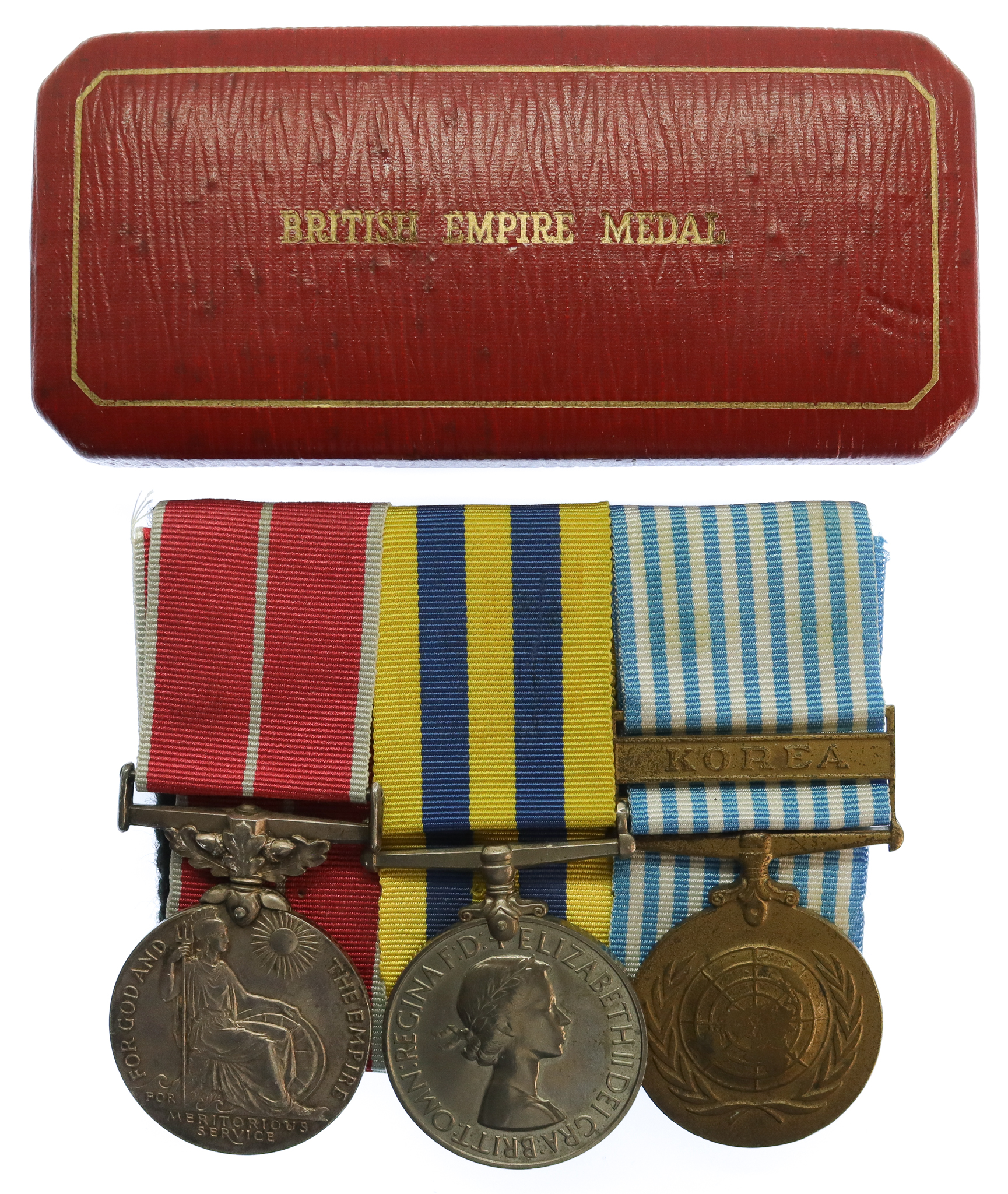
Korean War Glorious Gloster’s Battle of Imjin River Prisoner of War British Empire Medal Group of Three – Pte. D.C. Stockting, 1st Bn. Gloucestershire Regiment
$ 24.85
Korean War Battle of Imjin River Prisoner of War Medal GroupA superb Korean War Battle of Imjin River Prisoner of War British Empire Medal group awarded to 14468948 Private Donald Charles Stockting, 1st Battalion Gloucestershire Regiment (late Dorsetshire Regiment), who spent long periods in military prison and gave his gaolers hell — not least as a prisoner of the Chinese, when he “escaped from his Prisoner of War Camp and was at large for six days, during which time he travelled seventy miles in an attempt to reach the Allied lines,” being described as “a constant source of trouble to his captors.”Elizabeth II British Empire Medal (Military Division) named to 14468948 Pte. Donald C. Stockting, GlostersQueen’s Korea Medal named to 14468948 Pte. D.C. Stockting. GlostersUnited Nations Korea Medal unnamed as issued.B.E.M. Citation – London Gazette, 18 June 1954:“For gallant and distinguished services whilst a Prisoner of War in North Korea during the period April 1951 – October 1953.”The recommendation reads:“This soldier behaved in an exemplary manner whilst a Prisoner of War and was a constant source of trouble to his captors. With two other soldiers, he made an escape from his Prisoner of War Camp and was at large for six days, during which time he travelled seventy miles in an attempt to reach the Allied lines. Unfortunately, and through bad luck, this soldier was eventually recaptured by the enemy. He was fully aware before making his escape that, should he be recaptured he would suffer considerable hardship. This knowledge did not, however, deter him. His conduct whilst a Prisoner of War was far beyond the requirement of duty.”Early Life and Military ServiceStockting was born on 22 January 1928 in Swanage, Dorsetshire. Having worked as a mess boy, he attested for service with the British Army at Southampton on 30 July 1945, joining as a Private (No. 14468948) in the General Service Corps. He was transferred to the Class W Royal Army Reserve on 6 September 1945, and later posted to the Dorsetshire Regiment on 18 October 1945.He attended No. 2 Infantry Training Centre, where he went absent without leave and was placed in close arrest, being awarded 168 hours’ detention on 26 November 1945. Posted to the 1st Battalion, Dorsetshire Regiment, he was sent to Germany on 25 May 1946, and soon after received 14 days’ detention for misconduct. This pattern continued throughout his service in Germany and Austria, with regular periods of close arrest.This culminated on 15th September 1948 when he was sentenced by Field General Court Martial to seven months detention in close arrest for ‘striking his superior officer’. Released from military prison on 17th February 1949, he was once again tried by Field General Court Martial on 8th November 1949, this time for being absent without leave and his return, having been placed in close arrest, he ‘willfully and maliciously injured a cell door thereby occasioning damage to the amount of £3 and 2 shillings’. And then having been told by a Private Fripp of the Regimental Police who was in charge of the Stockting ‘to stand to attention, improperly threatened the said Pte Fripp by raising his fists and saying “I am not standing to attention”. He then proceeded to brandish a stick at one Sergeant Elbrow ‘at the same time saying “I will get you for this Elbrow see”’. Found guilty on some of the further charges, but interestingly not those made by Fripp and Elbrow, he was sentenced to a further six months in a military prison, and a stoppage of pay to clear the damages to the ‘willfully and maliciously injured cell door’! Two months of his detention were subsequently remitted. Whilst in prison, Stockting sustained ‘accidental injuries’ of a moderate severity on 20th May 1950, and was then released from prison in Austria on 20th July 1950.Korean War Service and the Battle of Imjin RiverWith the outbreak of the Korean War later that year, Stockting was posted to Japan, arriving on 10 December 1950, before joining the 1st Battalion, Gloucestershire Regiment in Korea on 17 February 1951. As such Stockting found himself manning a defensive position along the 38th Parallel during the Chinese Spring Offensive of April 1951, being present during the Glosters’ epic stand at Hill 235 — the famous Battle of Imjin River, 22–25 April 1951.The battle opened on the night of 22 April 1951, as Chinese forces advanced across the Imjin River, overwhelming forward positions and threatening the 29th Brigade’s line. Intense fighting saw the Belgian battalion forced to withdraw, while the Gloucestershire Regiment’s companies held key positions under heavy assault. Despite repeated attacks and severe casualties, the Glosters maintained their defense on Hill 235, known as Gloster Hill, for two days, ultimately being surrounded. Attempts to relieve the battalion by allied forces, including tanks and infantry, failed.Private Donald Charles Stockting was captured during the fall of Gloster Hill on 25 April 1951. Over the next 28 months as a prisoner of the Chinese and North Koreans, he endured harsh conditions, made a daring escape covering 70 miles before recapture, and consistently defied his captors. His bravery and unbroken spirit under extreme hardship were recognised with the award of the British Empire Medal, exemplifying the courage and determination of the Glosters during the Korean War.
Related products
-

Trade in Polk Audio RTi Speaker pack
-

Polk Audio Signature Mid-size Home theatre pack
-

Home Theater Pack 4